Bearded Retrievers
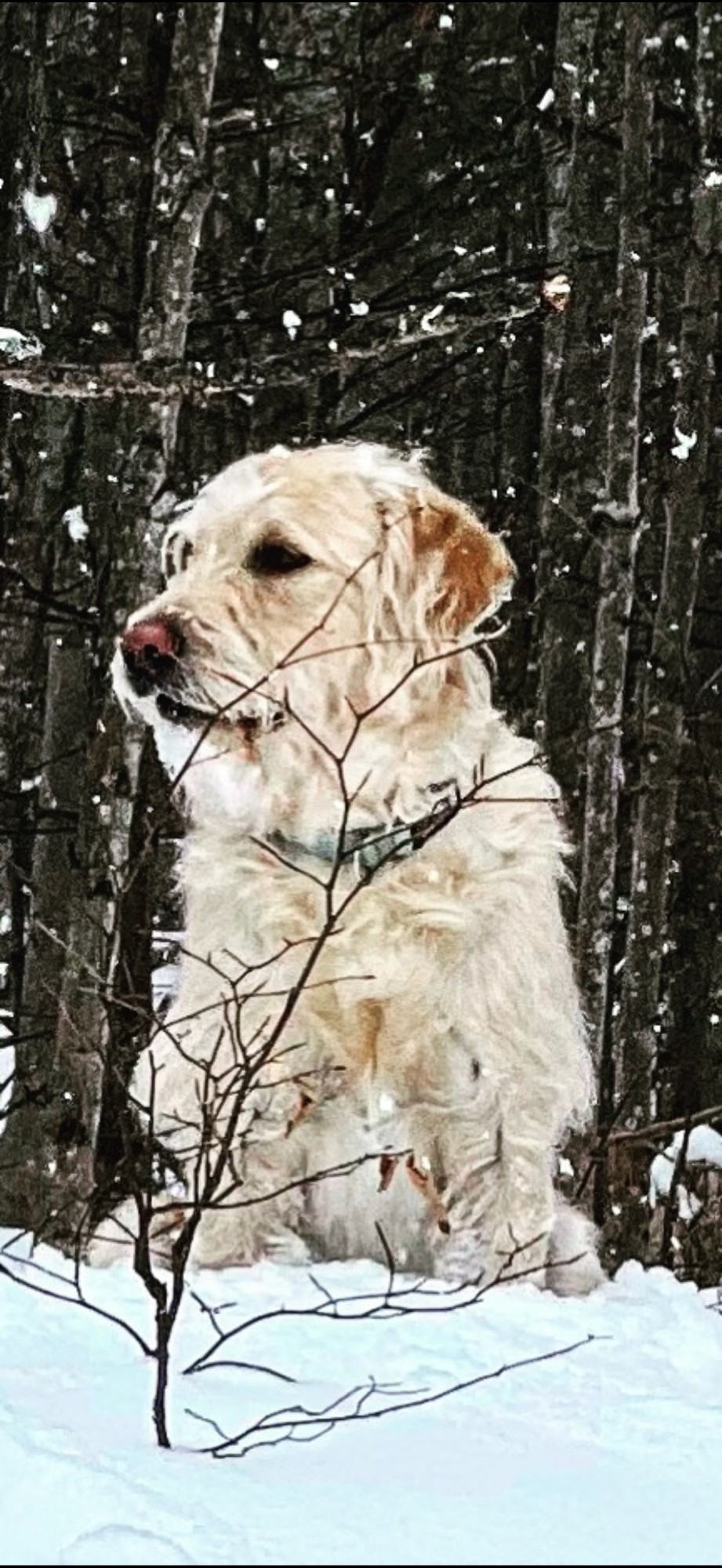
The Bearded Retriever is an open breed whose purpose is companionship: a reliably social, steady presence in the family and with everyone it meets.
HISTORY AND INSPIRATION
The retriever breeds descend from the St. John’s water dog, a landrace of working dogs that developed among the fishing communities of Newfoundland. These sturdy, medium sized dogs were valued for their endurance in cold water, their drive to retrieve, and a cooperative, good natured temperament. Brought to Britain through the fishing trade, they became the foundation of the Labrador Retriever and contributed to the Golden, Flat Coated, and Curly Coated Retrievers, while in the United States dogs of the same type gave rise to the Chesapeake Bay Retriever. The landrace itself dwindled under dog taxes and quarantine laws, and the last known St. John’s water dogs were photographed around 1980.
Lower shedding mixed breed dogs have been kept as companion dogs for decades. The Cockapoo, the first to become widely known, was established in the United States by the 1960s. In 1989 Wally Conron, breeding manager for the Royal Guide Dog Association of Australia, bred a Labrador Retriever to a Standard Poodle to produce a guide dog with a lower shedding coat. One puppy from that litter, Sultan, completed training and worked as a guide dog, and Conron named the cross the Labradoodle. Breeders in Australia and North America took up the cross during the 1990s, and the Goldendoodle, a Golden Retriever to Poodle cross, followed in the same decade and has become one of the most popular dogs in the United States.
Demand for mixed breed dogs with lower shedding coats has grown steadily since. It seems as though much of the demand has been driven by the fact that lower shedding dogs may be less likely to trigger allergies in humans. Allergies are individual, and no coat type is hypoallergenic for everyone. Lower shedding dogs remain appealing for their appearance and because they leave less hair on clothing and household items, and they appeal to many people who have no allergy concerns.
The Bearded Retriever was founded in 2017 by a group of companion dog breeders who wanted a lower shedding dog true to retriever type and temperament. They envisioned the Labrador Retriever, Golden Retriever, and Poodle as its foundation breeds.
The founding group organized as a breed club and drafted the first standard. In 2022 the project moved to the Companion Dog Project, where breeders have continued to breed toward the type.
PROJECT GOALS
The goals of the Bearded Retriever project are:
- Select for health by breeding against known heritable disease and prioritizing sound, healthy breeding stock.
- Select for a furnished, bearded face and a coat that sheds less than a traditional retriever coat, with less undercoat and no curl.
- Select for a size slightly smaller than current retrievers, consistent with the needs of most companion homes.
- Develop and maintain a recognizable type.
BREED STANDARD
Temperament
Temperament is the defining characteristic of the type and the highest selection priority. The Bearded Retriever carries forward the behavioral characteristics that have made the retriever one of the most successful family and service dogs in history.
The following characteristics are present with ordinary socialization, management, and training typical of pet homes and do not depend on behavior modification or specialized training.
The high drive required for success in many dog sports often works against Bearded Retriever temperament goals. Participation in dog sports is encouraged but is not considered evidence of Bearded Retriever temperament.
Registration as a therapy dog with a reputable national therapy dog organization, in combination with completion of the CDP temperament assessment, is considered the gold standard for Bearded Retriever temperament assessment at this time. The approved organizations are Pet Partners and Alliance of Therapy Dogs.
Desired Temperament
The Bearded Retriever is:
- Expressive, attentive, people oriented, and highly motivated to engage with humans.
- Accepting of handling by familiar and unfamiliar people, including people whose movement is unsteady, sudden, or unusual, and enjoys physical contact and proximity to humans.
- Tolerant of routine grooming, husbandry, and veterinary procedures including restraint, nail trimming, ear cleaning, bathing, brushing, and trimming.
- Low in sensitivity to noise, touch, novel surfaces, unfamiliar environments, and changes in daily routine, with confidence in new environments and quick recovery from startling events.
- Strong in food motivation and handler focus, which exceed interest in environmental distractions including wildlife and other moving animals.
- Possessed of a natural retrieve instinct, affinity for water, and strong swimming ability, and picks up, carries, and releases items willingly without obsessive object focus or possessive carry.
- Hardy and cold tolerant, comfortable spending time outdoors in cold weather.
- Comfortable traveling in vehicles, with little tendency toward motion sickness or anxiety related to travel.
- Tolerant of routine confinement, separation, and periods of inactivity without distress, excessive vocalization, agitation, or destructive behavior.
- Moderate in exercise requirements, settling comfortably in the home without excessive physical exercise or constant mental stimulation.
- Neutral or friendly toward unfamiliar dogs and peaceful with household pets.
Undesirable Traits
Undesirable traits include:
- Excessive arousal.
- Excessive vocalization.
- Fearfulness in new environments or with new experiences.
- Conflict with other dogs.
- Aggression toward humans.
- Resource guarding.
- Separation distress.
- Submissive urination.
- Pica.
- Coprophagia.
- Slow recovery from startling events.
- Prey drive or an intact predatory sequence.
- Sharpness.
- Sensitivity to wearing collars, harnesses, or other equipment.
- Difficulty adapting to change.
Structure and Type
Overall Shape and Size
The Bearded Retriever is a moderate dog, slightly longer than tall, with sturdy bone in proportion to its size.
The ideal Bearded Retriever is 18 to 22 inches at the withers and 30 to 50 pounds. Size outside this range is a fault.
Head, Body, and Movement
The head is broad with an attentive, engaged expression. Eyes are medium sized, round, neither protruding nor deep set, and spaced to give a friendly expression, neither too far apart nor too close together.
The muzzle is broad and about equal in length to the skull.
Ears are pendant, set slightly above eye level, and hang close to the head.
The neck is long and well muscled. When the dog stands stacked, the neck extends forward from the shoulders.
The chest reaches to the elbow and no deeper, and is wide enough to leave room between the front legs without being barrel shaped. The underline rises only gently from the chest to the loin.
A visible forechest extends ahead of the front legs. Pasterns are nearly upright with a slight slope. Feet are compact with arched toes.
The topline is level and remains firm in motion.
The shoulder blade is well laid back and the upper arm is about as long as the shoulder blade, so that the front legs stand under the withers rather than out in front of them.
Rear angulation matches the front. The stifle is well bent.
The hock is short and perpendicular to the ground when viewed from the side, and the rear legs are parallel when viewed from behind.
The croup is gently sloping.
The withers are level with or slightly above the rear.
Movement is balanced and effortless. At a trot, the neck extends forward and the head is carried slightly in front of the body rather than directly above it.
The tail is thicker at the base, tapering toward the tip, and carried as an extension of the topline.
Faults
- Excessively straight front
- Weak pasterns
- Flat feet
- Straight stifles
- Sway back
- Roach back
- Excessively steep croup
- Rear higher than shoulders
- Excessively high tail carriage
- Upright tails
- Curled tails
- Cow hocks
- Deep, narrow chest with pronounced tuck up
Coat
The coat is the second hallmark of the Bearded Retriever. The Bearded Retriever is a furnished type, expressing the beard, mustache, and eyebrows produced by the RSPO2 furnishings gene. In short haired dogs, furnishings produce the rough, or wire, coat.
Rough Coat
The rough coat is short to medium in length and lies close to the dog. Texture may be harsh, wiry, or plain. Undercoat should be minimal. Moderate shedding is acceptable.
Faults
- Curl
- Heavy undercoat
- Coat prone to matting
- Unfurnished coat
Color
Colors and markings other than those specifically prohibited are permitted.
Pigment of the nose, lips, and eye rims should be solid and complete.
Faults
- Progressive graying
Prohibited Colors and Markings
- Dilute colors
- White covering more than 40% of the total body area, or white on the face extending over any part of the ear or the eye rims
Merle
Merle is not to become a defining characteristic of the type. Because merle is a dominant trait that restricts pairings, merle and hidden merle puppies should make up no more than about 25% of the puppies a program produces in Foundation and Bearded Retriever litters.
Genetic testing for merle, including merle allele length, is required on both parents of any breeding involving a merle dog. Documented purebred retrievers are exempt from merle testing. Breedings with the potential to produce health effects related to merle are strictly prohibited.
Breeding dogs with hidden merle is discouraged. Buyers of hidden merle puppies must be informed of the puppy’s merle status. Merle and hidden merle puppies should be sold on pet contracts unless sold to a known responsible breeder.
BREEDING AND REGISTRATION
Requirements for Registration
Because the Bearded Retriever is a type in active development, registration requirements may change over time.
Bearded Retriever registration is based on pairing qualification and litter registration. A dog acquires registration status as part of a litter, never as an individual adult.
Foundation and Development of Type
The Bearded Retriever is developed through selection on individual dogs rather than through restriction of ancestry. Within any mixed litter, individual puppies differ in tail set, head shape, bone, coat, and temperament, and the puppies that express retriever type in structure and disposition should be the ones retained for breeding. Type is developed by consistent selection across generations.
Bearded Retriever - Foundation
Litters that meet the following requirements are registered as Bearded Retriever - Foundation. Foundation registration is expected to remain permanently available to allow ongoing development of new lines and the introduction of new genetic material into the type.
- The expected average breed content of the puppies must be at least 15% retriever.
- CDP temperament assessment completed on both parents.
- At least one parent must carry at least one copy of the furnishings allele.
- Copper toxicosis genotype (ATP7B and ATP7A) documented on both parents.
- The expected litter ancestry must include at least three breeds. Poodle varieties (Standard, Miniature, and Toy) are treated as a single breed for this purpose.
- Stacked side and front photographs of both parents are posted on their Companion Dog Registry profiles.
Retrievers are expected to form the base of the type, with other breeds contributing size reduction and coat traits.
The following breeds are not permitted:
- Wolf content
- Terriers
- Bulldogs
- Mastiffs
- Guardian breeds
- Breeds developed primarily for guarding, protection, fighting, livestock defense, territorial aggression, or vermin control
Exceptions may be considered when an individual dog is likely to make a substantial contribution to the development of the Bearded Retriever and is consistent with the temperament goals of the project.
*A breeder must produce at least one litter qualifying for Bearded Retriever registration within five years of registering their first Foundation litter in order to continue registering Foundation litters.
Bearded Retriever
Litters that meet the following additional requirements are registered as Bearded Retriever.
- The expected adult weight of the puppies is 25 to 65 pounds.
- Neither parent has any copies of CDDY.
- Neither parent is a purebred of any breed other than a retriever.
- No puppies are expected to carry a curl gene of either type.
- No puppies are expected to carry two copies of the accumulating copper toxicosis variant (ATP7B).
- At least one parent has documented proof of Bearded Retriever temperament through an approved therapy dog certification or the video component of the CDP temperament assessment (under development).
- The expected average breed content of the puppies is 49% or less Poodle, with all Poodle varieties combined.
- The stacked side and front photographs of both parents demonstrate recognizable Bearded Retriever type. This is expected to require significant retriever percentage, often greater than 50%.
Multigenerational breedings carry the same registration requirements. Each pairing should be evaluated individually to determine eligibility of the litter.
© 2026 Companion Dog Project. All rights reserved.
Bearded Retriever and Bearded Retriever - Foundation are registration designations issued by the Companion Dog Registry to litters meeting the requirements in this document. Use of these designations for dogs not registered by the Companion Dog Registry is not authorized.